
Investing in a concrete plant for sale in Chile involves more than comparing equipment quotations. Production capacity, mixer configuration, transportation, installation conditions and long-term operating expenses all influence the total investment. Whether supplying urban construction projects, mining infrastructure or remote road developments, buyers need to evaluate how each configuration affects actual production costs. Understanding these factors helps contractors select suitable concrete mixing plants in Chile and avoid paying for unnecessary capacity or equipment.
How Much Does a Concrete Batching Plant Cost in Chile?
The purchase price varies considerably depending on plant type, production capacity and configuration. A compact mobile unit generally requires less initial investment than a large stationary ready-mix concrete plant with multiple aggregate storage bins and automated control systems.
As an initial budgeting reference, buyers can consider the following indicative equipment price ranges. Actual quotations depend on technical specifications, optional equipment and shipping arrangements.
| Plant Type | Typical Capacity | Indicative Price Range |
|---|---|---|
| Small mobile plant | 20–60 m³/h | $38,000–$90,000 |
| Medium mobile plant | 60–90 m³/h | $80,000–$120,000 |
| Stationary batching plant | 50–240 m³/h | $33,000–$210,000 |
These figures are preliminary equipment-budget references rather than fixed market quotations in Chile. They do not necessarily include international freight, customs duties, civil works, electrical connections or commissioning. Therefore, comparing the complete delivered and installed investment provides a more reliable basis for evaluating a concrete plant for sale(planta de concreto en venta).
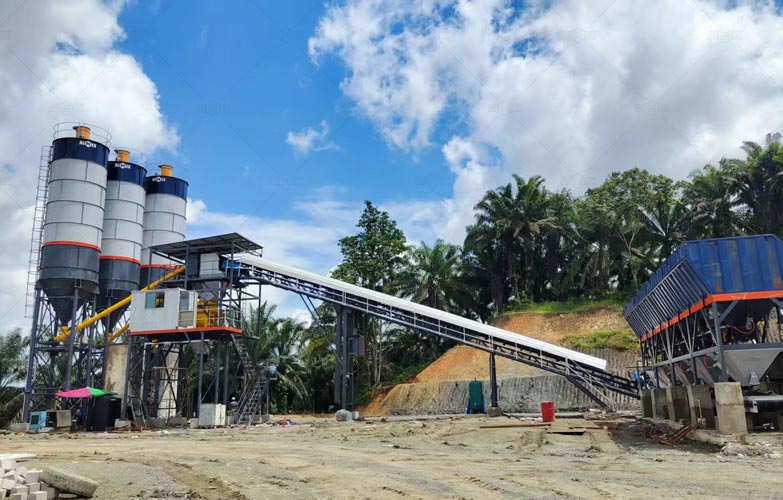
Key Factors That Affect Concrete Plant Prices
1. Production Capacity and Actual Demand
Capacity is one of the most important price determinants. A plant rated at 120 m³/h typically requires a larger batching system, more powerful mixing equipment and higher aggregate-handling capacity than a 50 m³/h model.
However, selecting the largest available model does not automatically improve profitability. Buyers should estimate hourly concrete demand, daily operating hours, peak-season requirements and expected project duration.
- Small projects: 20–35 m³/h may provide sufficient output.
- Medium construction projects: 50–90 m³/h can support more consistent concrete supply.
- Large infrastructure projects: 120–240 m³/h may be appropriate when demand is continuous.
Actual output also depends on aggregate loading, batching accuracy, mixing cycles, truck availability and material supply. A correctly sized plant can achieve better equipment utilization and lower investment per cubic meter than an oversized installation.
2. Mixer Type and Configuration
The mixing system directly affects both the purchase price and concrete production performance. Twin-shaft compulsory mixers are commonly selected for commercial concrete production because they provide efficient, uniform mixing. Planetary mixers may be preferred for certain specialized concrete applications, while drum mixers are associated with simpler mixing requirements.
Beyond the mixer itself, the batching system, aggregate bins, cement silos, weighing equipment and conveyor configuration also influence the quotation. A ready-mix concrete plant equipped with multiple storage compartments and automated weighing controls generally requires a higher investment than a basic configuration.
Buyers should evaluate the required concrete quality and production process before selecting optional components. Adding equipment that does not improve project productivity can unnecessarily increase the concrete plant price.
3. Mobile or Stationary Plant Selection
Site conditions in Chile can significantly influence equipment selection. Projects in metropolitan areas may prioritize stable production and continuous concrete delivery, while mining operations and infrastructure developments in remote regions often require flexible equipment deployment.
A stationary ready-mix concrete plant is suitable for long-term production at a fixed location. Its foundation, aggregate storage and material transportation systems can be designed around sustained output.
Mobile concrete mixing plants offer easier relocation and faster installation. They can be particularly useful for temporary construction sites, road projects and operations with changing production locations.
4. Transportation and Installation Costs
Chile’s long geographical extension creates different logistics requirements between coastal cities, central industrial areas and remote mining regions. International shipping, inland transportation, container loading and equipment unloading should all be included in the investment calculation.
Installation costs also depend on site preparation. Foundation construction, electrical infrastructure, water supply, cement silo assembly and commissioning may require additional expenditure. In mountainous areas, restricted site access and difficult terrain can further increase transportation and construction costs.
When evaluating concrete mixing plants in Chile(plantas hormigoneras en Chile), request a quotation that clearly separates equipment prices from shipping, installation and other project expenses.
5. Automation and Environmental Equipment
Automation influences the initial investment but can reduce operational inefficiencies over time. Computerized batching systems help control material proportions, monitor production records and improve consistency between batches.
Environmental configurations also deserve attention. Cement silo dust collectors, enclosed aggregate storage, wastewater recycling systems and appropriate noise-control measures can help plants meet project-specific environmental requirements.
For projects near residential areas or environmentally sensitive locations, these components should be considered during the initial equipment selection rather than added after installation.
How to Calculate the Total Investment and ROI
The equipment quotation represents only one part of the financial commitment. A more realistic investment assessment should include the following cost categories:
- Equipment purchase: batching system, mixer, silos and optional components.
- Transportation: international freight, inland delivery and unloading.
- Installation: foundations, assembly, electrical work and commissioning.
- Operating expenses: cement, aggregates, water, electricity, labor and maintenance.
- Compliance: applicable permits and environmental protection facilities.
Buyers should also estimate the cost per cubic meter of concrete and compare it with the expected selling price or internal construction cost. For a commercial ready-mix concrete plant(planta de concreto premezclado), monthly break-even production can be estimated by dividing fixed monthly costs by the contribution margin per cubic meter.
This approach helps determine whether a higher initial investment in automation or production capacity can generate sufficient savings and additional revenue over the equipment’s service life.
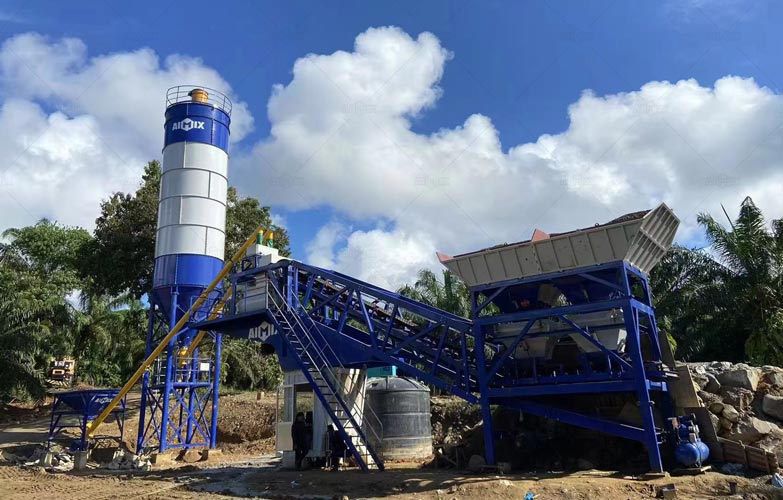
AJP40 Mobile Concrete Plant with Pump: An Integrated Option
For construction projects requiring both concrete production and on-site delivery, an integrated solution can reduce dependence on separate equipment. The AJP40 mobile concrete plant with pump combines batching and concrete pumping functions in one configuration, with a rated production capacity of 40 m³/h.
This arrangement is worth considering for road construction, building foundations and projects where transporting fresh concrete from a distant ready-mix facility is inconvenient. Its mobile configuration also provides greater flexibility when working locations change.
When comparing the AJP40 mobile concrete plant with pump(AJP40 planta de concreto móvil con bombeo) against conventional concrete mixing plants in Chile, buyers should consider the complete workflow, including pumping distance, placement requirements, site access and daily concrete demand. The most economical solution is not necessarily the one with the lowest purchase price, but the one that delivers the required concrete efficiently throughout the project.
Before purchasing a concrete plant for sale, prepare your expected production capacity, project location, concrete specifications and installation requirements. With these details, suppliers can recommend a suitable configuration and provide a more accurate quotation, helping you control the initial investment while maintaining reliable concrete production.