
In the world of heavy lifting, the assumption is often that “strength” is the primary requirement. If the crane is big enough and the slings are thick enough, the job is a success. However, for those specializing in precast concrete elements, strength is only half the equation. The other half is geometry.
Concrete is a material of contradictions: it possesses incredible compressive strength but is notoriously brittle under tension and torsion. When a precast beam, wall panel, or volumetric module is lifted by a rubber tired crane, it undergoes a radical change in its internal stress distribution. A beam designed to be supported from the bottom in its final position is suddenly “hung” from the top. Without an optimized rigging geometry, these transitions can induce structural cracks, surface spalling, or even catastrophic failure.
Optimizing rigging geometry is the science of aligning lifting forces with the structural integrity of the precast element. Here is how engineers and rigging specialists minimize stress during the “critical lift.”
1. The Physics of the Sling Angle
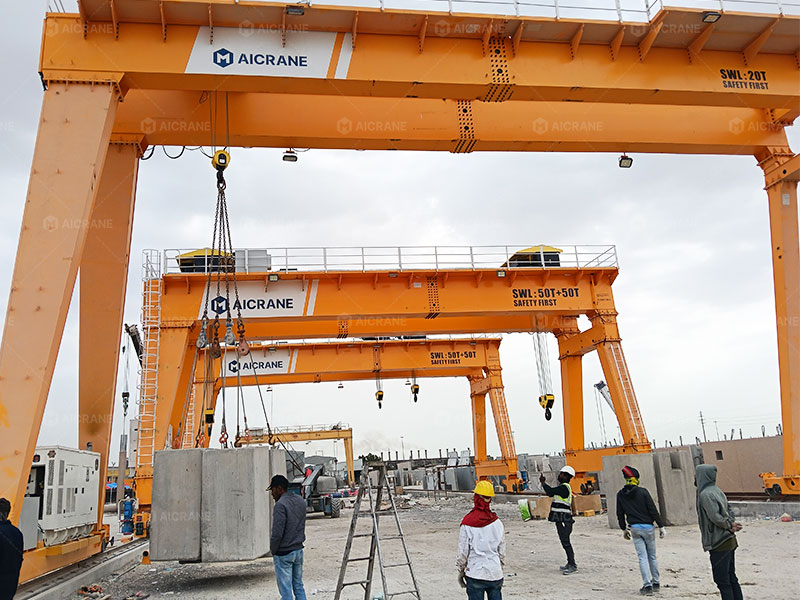
The most fundamental element of rigging geometry is the horizontal sling angle. Many inexperienced crews believe that longer slings (which create a sharper, more vertical angle) are merely a matter of convenience or overhead clearance. In reality, the angle of the sling dictates the “crushing force” applied to the precast element.
When slings are rigged at a shallow angle (e.g., 30 degrees from the horizontal), a massive amount of compressive force is directed inward along the top of the precast element. For a long, slender concrete beam, this inward force can cause the member to buckle or “bow” horizontally.
-
The 60-Degree Rule: As a standard best practice, rigging should aim for a horizontal sling angle of 60 degrees or greater. This ensures that the majority of the force is directed vertically (lifting the load) rather than horizontally (crushing the load).
-
The Penalty of Shallow Angles: At a 30-degree angle, the tension in each sling is equal to the total weight of the load. This not only stresses the concrete but also requires significantly higher-rated rigging hardware.
2. Leveraging Spreader Beams and Lifting Frames
To completely eliminate the inward compressive forces mentioned above, engineers utilize Spreader Beams. A spreader beam is a compression member that takes the “crush” so the concrete doesn’t have to.
How it Optimizes Geometry: By using a spreader beam, the slings descending to the precast element remain perfectly vertical (90 degrees). This ensures that the lifting anchors in the concrete are pulled straight up, which is their strongest orientation.
For complex shapes, such as L-shaped bridge girders or asymmetrical architectural panels, a Lifting Frame (a grid of spreader beams) is used. This allows for multiple pick points—sometimes six or eight—to distribute the weight so that no single section of the concrete is overloaded.
3. Managing the Center of Gravity (CoG) and Eccentricity
One of the most common causes of stress is an unbalanced lift. If the Center of Gravity (CoG) is not directly beneath the gantry crane hook, the element will tilt as soon as it leaves the ground.
When a precast element tilts, the stress distribution becomes “eccentric.” One lifting anchor may suddenly carry 80% of the load while the other carries 20%. This imbalance can exceed the “safe working load” of the anchor and cause it to pull out of the green concrete.
Optimization Strategies:
-
Adjustable Slings: Using “shorteners” or chain clutches allows the rigging crew to fine-tune the lengths of individual legs until the load sits perfectly level.
-
The Offset Hook Strategy: For elements with heavy internal components (like a precast bathroom pod with plumbing on one side), the crane hook must be intentionally offset toward the heavy end to ensure a level lift.
4. Resolving Torsion in Multi-Point Lifts
For large-area elements like floor slabs or bridge deck segments, a four-point lift is standard. However, four-point rigging is “statically indeterminate.” If one sling is even slightly shorter than the others, or if the ground isn’t perfectly level during a move with a Straddle Carrier, the load will “rock” on two diagonal points.
This creates Torsion (twisting). Concrete has very little resistance to twisting forces, which leads to “corner cracking.”
The Solution: The Three-Point Suspension Philosophy To minimize torsion, engineers often use a Leveled Rigging System or a “whiffletree” arrangement. By using an equalizer beam or a snatch block (pulley) on one side of the lift, two of the four points are linked. This allows them to act as a single, pivoting point. The result is a “virtual three-point lift” that allows the slab to settle into equilibrium without twisting, regardless of minor rigging imbalances.
5. Account for “Stripping” and “Suction” Stresses
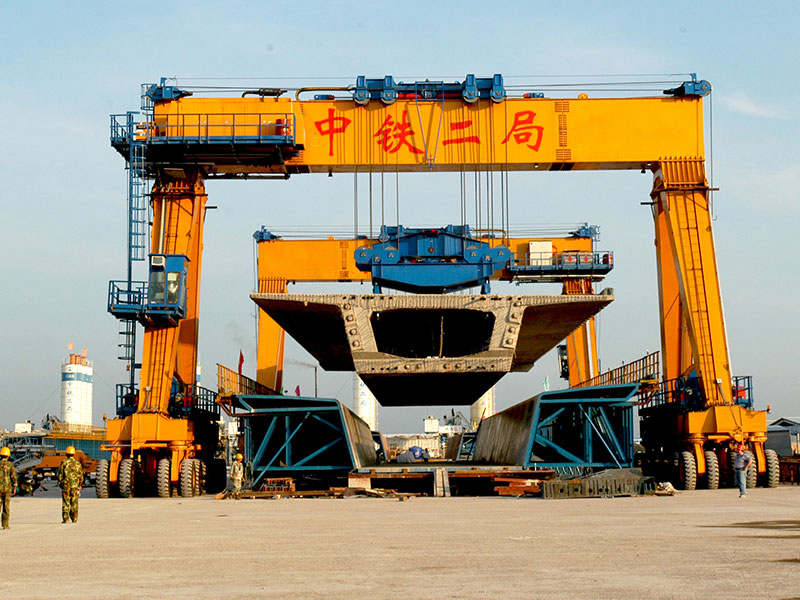
The most stressful moment for a precast element isn’t during transit; it’s the moment it is removed from the mold (the “stripping” phase).
When a wall panel is lifted out of a horizontal mold, it must overcome “form suction.” This is a vacuum effect created between the smooth concrete and the steel mold. If the rigging geometry is too rigid, the force required to break the suction can exceed the cracking limit of the “young” concrete.
Optimization Tech:
-
Rolling Blocks: Using pulleys in the rigging allows the panel to be tilted from horizontal to vertical smoothly, distributing the suction-break force across the entire surface area rather than concentrating it at the top anchors.
-
Initial Peeling: A slight offset in the rigging geometry can allow one corner of the panel to “peel” away from the mold first, breaking the vacuum seal before the full weight is engaged.
6. Dynamic Load Factors and Hook Speed
Rigging geometry doesn’t just exist in a static state; it must account for Dynamics. When a crane starts a lift or brakes suddenly, the “dynamic load factor” can double the effective weight of the element for a split second.
If the rigging geometry is “stiff” (e.g., using very short, non-elastic wire ropes), these shocks are transmitted directly into the concrete.
-
Nylon/Synthetic Slings: For certain precast elements, synthetic slings are preferred because they have a small amount of “stretch” (elasticity). This acts as a shock absorber, smoothing out the peaks of dynamic stress during travel.
-
Inverter-Controlled Winches: Modern Gantry Cranes and Straddle Carriers use frequency inverters to provide “soft starts” and “soft stops,” ensuring that the geometry of the rigging remains stable and free from violent oscillations.
7. The Role of Edge Protection and Softeners
Even with perfect geometry, the physical contact between rigging hardware and concrete can cause damage. Steel wire rope or chains can “saw” into the edges of a precast element if the sling angle isn’t perfectly vertical.
Best Practices:
-
Corner Protectors: Using heavy-duty plastic or rubber “softeners” at any point where a sling wraps around a concrete edge.
-
Protecting the “Fair-Faced” Finish: For architectural precast, rigging must be designed to avoid any contact with the visible faces, often requiring internal lifting sockets rather than external slings.
Conclusion: Engineering the Invisible
Optimizing rigging geometry is about making the invisible forces of physics work for you rather than against you. By maintaining steep sling angles, utilizing spreader beams to eliminate compression, and applying the three-point suspension philosophy to prevent torsion, we can move massive precast elements with surgical precision.
For the project manager and the rigger, the goal is simple: the precast concrete should never “feel” the lift. When the rigging geometry is perfectly optimized, the element remains in a state of equilibrium, ensuring that the structural integrity designed in the factory is the same integrity delivered to the job site. In the world of precast, the right geometry is the ultimate insurance policy.